The “0 ACCIDENTS” project is entering its final phase
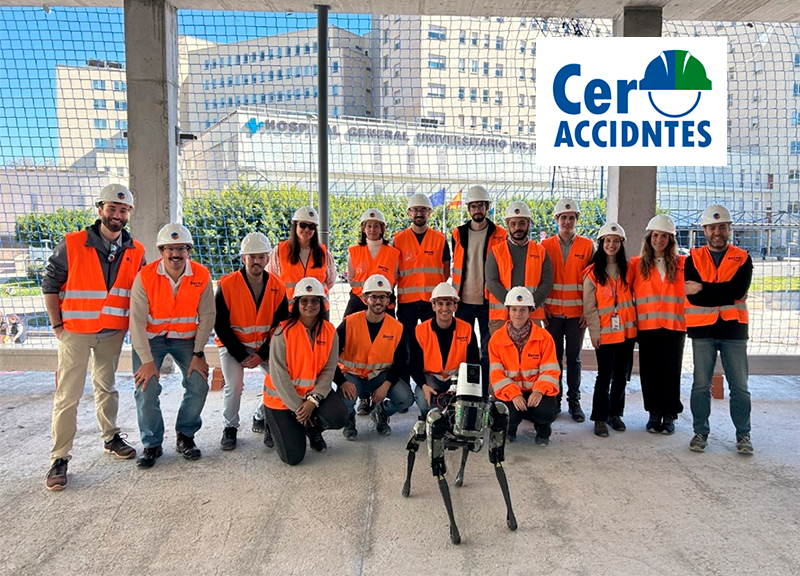
The “0 ACCIDNTES” project has successfully completed its final validation tests in real-world construction settings. These tests were conducted at two sites: the Tenerife Ring Road project, where FCC Construcción is building a large-scale tunnel; and a BECSA construction site in Alicante. Both projects consolidate a technological ecosystem designed to minimize risks in high-rise construction and linear underground works.
Both tests brought together representatives from the eight companies that make up the consortium: BECSA, FCCCO, Alisys, Signe, IDP – A Bureau Veritas Company, LIS Data Solutions, Fractalia, and MEPLASJAR, as well as the ITA, CETIM, and AIMPLAS Technology Centers. During the visits, the partners were able to validate the systems’ performance in a real-world controlled setting, with the aim of integrating all project developments into the tests.
Tenerife Island Ring Road: Safety in Tunnels and Enclosed Environments
In FCC Construcción’s Tenerife Island Ring Road project, advanced capabilities were demonstrated to protect workers in underground and highly complex environments. The main focus was the creation of a connected work environment:
- Prevention of Accidents: Using a multi-agent perception system (sensors on heavy machinery and fixed posts), a digital representation of the environment was created to predict collisions and issue real-time alerts to drivers.
- Air Quality Digital Twin: A model was validated that predicts pollutant concentrations in confined spaces, enabling the optimization of ventilation systems and the protection of staff health.
- Smart Data Management: The entire infrastructure to integrate this information was developed by teams specializing in Big Data, allowing safety technicians to review incidents and risks from a centralized digital platform
Alicante Hospital: Robotics and PPE Management
In this project for the new research building at Alicante Hospital by BECSA, the state-of-the-art “Spot” robot was used to autonomously inspect the construction site. The primary focus was to validate the following solutions:
- Multi-Story Autonomous Navigation: The generation of 3D maps and their conversion into 2D maps was validated for the robot dog’s autonomous navigation during inspection tasks across multiple floors.
- Automatic Occupational Risk Detection: Use of “Spot” to identify failures in the use of personal protective equipment (PPE) and collective protection measures on the construction site.
- Smart PPE: Final testing of the smart helmet and smart harness, designed to ensure workers are properly secured to lifelines.
- Real-World Prototype Validation: Testing of the comprehensive system under real construction conditions to ensure its effectiveness prior to final deployment.
All information generated by sensors, air quality monitoring, “Spot,” and predictive models is integrated into a comprehensive management platform. This tool centralizes all the project’s technological developments, facilitating intelligent and automated decision-making to achieve the goal of zero accidents in the construction sector.
Thanks to the synergy between Artificial Intelligence, mobile robotics, and digital twins, the project funded by the CDTI demonstrates that it is possible to digitize occupational risk prevention. The success of these demonstrators places the Spanish construction industry at the forefront of Industry 4.0 technology, always focused on the goal of zero accidents.